
Diesel Fuel & Cotton Wicks
Cotton Wicks in Modern Catalytic Heaters for Burning Diesel Fuel
THE ONLY ALL-COTTON 0RIGNAL EQUIPMENT HEATER WICKS ARE: |
Due to the extreme price differential between kerosene and diesel fuel, many people are now contemplating burning diesel fuel in their modern catalytic burner design heater. Flame spreaders were invented and patented in 1885 for center draft lamps, then the lamps were scaled up as heaters. All of the "traditional" heaters made until the early 1980's were of flame spreader design, when production effectively ended for this style heater. Catalytic burners were developed in Japan in the mid to late 1970's to promote cleaner burning by raising the flame temperature directly above the wick in a catalytic cylinder and quickly replaced the older flame spreader design concept heaters. That higher temperature at the top of the wick mandated a new wick material - fiberglass fibers - which could take that heat because cotton was quickly consumed by the heat. But fiberglass wicks are quickly fouled and ruined by the burning of diesel fuel.
Diesel engines have their fuel pump bearings lubricated by the fuel. There IS an oily component in diesel fuel because fuel injector pumps are quite expensive. And that oily component results in a rapid buildup of tar and carbon deposits on top of the wick. That deposit of tar ruins capillary action and can quickly build to the point that the wick cannot even be retracted to shut off the heater - a dangerous situation for a device used inside a home.
Isopropyl alcohol can be mixed with diesel to thin it, absorb most of the oily component in diesel fuel, and raise the flame temperature. Click here to jump to the discussion below of mixing alcohol with diesel fuel.
There is an interesting article from India describing a scientific test of alcohol mixed with kerosene for use in wick-type cooking stoves. This information has relevance to using an alcohol/diesel fuel mixture in wick type appliances. It should be noted the wicks used in the test stove were all-cotton. While the highest admixture of alcohol to kerosene was 40% the rate of cotton burn-down was not recorded; mixtures of alcohol over 20% would definitely result in the cotton wick itself burning, but with multi-wick stoves such as used in the test that particular "feature" is not a problem. An alcohol blend of diesel fuel would react the same way with all-cotton wicks with the burn down rate being controlled by the percentage of alcohol in the blend so that the wick was consumed at the same slow rate as the build-up of tar and carbon deposits on the top of the wick. Special thanks go to Dale Goodman for sending me this article. Click here for Ethanol-Kerosene Blends article.
Burning diesel with cotton wicks in a catalytic burner heater is an experiment by the purchaser and user of the wicks and no guarantee can be extended either to the wick or attaining the desired result. ALL CATALYTIC BURNER HEATERS USE A FIBERGLASS WICK, PERIOD. THERE ARE NO EXCEPTIONS. THERE HAS NEVER BEEN ALL-COTTON WICKS MADE FOR CATALYTIC BURNER HEATERS, PERIOD.
Images of catalytic burner units: ALL HEATERS MADE SINCE 1984 ARE OF CATALYTIC BURNER DESIGN AND HAVE ALWAYS USED FIBERGLASS WICKS.
|
|
|
| Catalytic burner, partially lifted. | Catalytic burner, bottom side. | Catalytic burner, profile. |

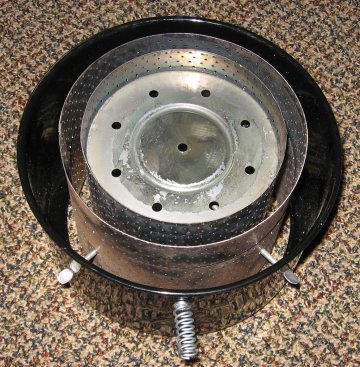
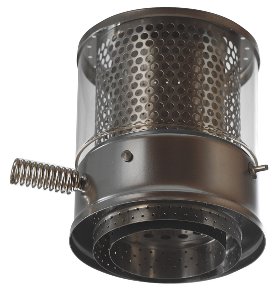
-- FLAME SPREADER HEATERS HAVE ALWAYS USED ALL-COTTON WICKS
More information on flame spreader heaters, click here.
|
|
|
| Perfection heater font & gallery with flame spreader on top. | Profile view of Perfection heater flame spreader. | Flame spreader heater burning - the flame is visible around the flame spreader - there is no catalytic burner covering the flame. |
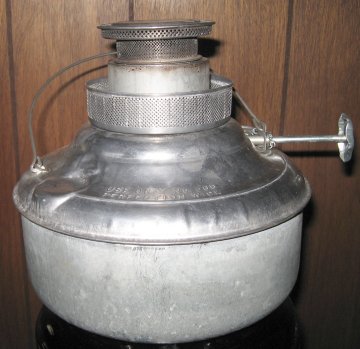


COMMENT FROM A CUSTOMER WHO HAS EXPERIMENTED EXTENSIVELY USING A DIESEL FUEL MIX IN HIS HEATER - recommended reading! (Click here)
CUSTOM MADE ALL-COTTON WICKS FOR SELECTED HEATERS.
Cotton #3L | 2 9/16'' (64 mm) diameter all-cotton wick to replace fiberglass wick #4E for those who want to try burning diesel fuel with a pint of alcohol per gallon in a Heat Mate/Sengoku HMN/CTN-110 radiant heater. Not guaranteed as diesel fuel varies in oil content. Wick #3L commercial factory wick IS AVAILABLE >> | Order on WickShop.com | |
The wicks below are currently available. (Other Custom wicks) | |||
| Cotton #6Z | 2 15/16'' (75mm) diameter wick (#6, #6A, 6X, 24) for those who wish to burn an all-cotton wick with diesel fuel. Not guaranteed as diesel fuel varies. All-cotton wick to replace fiberglass wicks #6X, #9A, #19, #24, etc. Custom wick using thick cotton woven wick material. To see list of heaters using wicks #6, #6A, 6X, 24, click here. | Order on WickShop.com | |
| Cotton #30Z | 2 15/16'' (75mnm) wick (#30) x 8 1/2'' long, for those who wish to burn an all-cotton wick with diesel fuel. Not guaranteed as diesel fuel varies. All-cotton wick to replace fiberglass wicks #6X, #9A, #19, #24, etc. Custom wick using thick cotton woven wick material. See the heaters wick #30 fits. This wick is essentially a longer wick #6X. To see which heaters use wick #30 click here. | Order on WickShop.com | |
| Cotton #1Z | 3 3/8'' (85mm) diameter wick (#1, #1A, #1D, #1X & #2) for those who wish to burn an all-cotton wick with diesel fuel. Not guaranteed as diesel fuel varies. All-cotton wick to replace fiberglass wicks #1X and #2. NOT FOR REPLACING PINNED WICK #2A!!! Custom wick using thick cotton woven wick material. To see list of heaters using wicks #1X, #2, click here. | Order on WickShop.com | |
Cotton #7Z | 3 3/4" wick for Alpaca and others using wick #7X. 95 x 2.5 x 183mm (3 3/4'' x 0.095'' x 6 1/8'' long). | Order on WickShop.com | |
| Cotton #5Z | 4 1/8'' (105mm) diameter wick ((#5, #5A, #5X, #14 & #21) for those who wish to burn an all-cotton wick with diesel fuel. Not guaranteed as diesel fuel varies. All-cotton unpinned wick NOT to replace pinned wicks #5B and #5C. Custom wick using thick cotton woven wick material. To see list of heaters using wicks #8, click here. | Order on WickShop.com | |
| Cotton #8Z | 4 3/4'' (120mm) diameter wick (#8) for those who wish to burn an all-cotton wick with diesel fuel. Not guaranteed as diesel fuel varies. All-cotton wick to replace fiberglass wicks used in . Custom wick using thick cotton woven wick material. To see list of heaters using wicks #8, click here. | Order on WickShop.com | |
Many people have asked if Dyna-Glo convection can have cotton wicks made for them, and the answer is NO, they use pinned wick #3C. If a convection heater uses pinned wick #3C, it was made by Dyna Glo. That heater was sold under quite a variety of brand names, including DuraHeat DH2300, 2301, 2302, 2303, 2304, the KeroHeat CV-2300, Dyna Glo CV2300, all models of RMC 95C & D + number, CV2300, 2301, 2301, 2303, 2304, etc, KC-2404, - 2404b; KW-2400 (all series: 2400, 2401, 2402, 2403, 2404); KW-24, -24B, -24C (all KW-24's and 2400's).
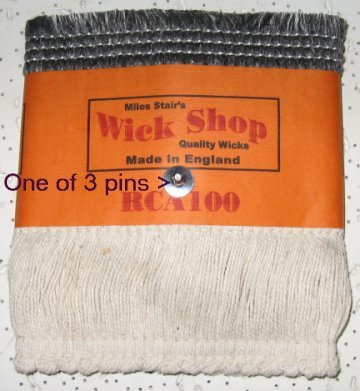
For a more complete list of wicks by number and if they have pins, click here. The photo at right shows one of three pins on the wick, the other two pins being on the back of the wick. Note that the distance from the top of the wick down to the pin varies according to the design specifications of the manufacturer, the pin placement of the wick on the right being the lowest placement of any wick; it was just a more convenient and pretty picture. |
|
ADDING ALCOHOL TO DIESEL
Quite a few experimenters have posted videos and articles online regarding burning diesel fuel altered with alcohol. The alcohol raises the flame temperature of the diesel fuel and that helps burn off the deposits on the top of the wick. Because diesel fuel varies in consistency from one area of the country to another, even from winter to summer, no absolutes can be given to the amount of alcohol that should be added per gallon of diesel fuel can be listed - experimentation is required. The alcohol used should be at least 91% pure and can be purchased from some pharmacy stores. Denatured alcohol can also be used and is available at most hardware stores.
To show how the quantity of isopropyl alcohol added per gallon is extremely critical, I ran some experiments using different amounts of fuel in diesel and burned it in easily-photographed mini-burners. The quantities of alcohol listed below are for QUARTS, not gallons. And please note I was using isopropyl alcohol, NOT denatured alcohol. [The text in the photos says denatured alcohol, but those photos were taken last year when I was using denatured from an old container I purchased years ago. The summer of 2016 I was having problems with a new can of denatured and it did not mix with kerosene. See below. Now I only use isopropyl alcohol.]
|
|
|
| 2.5 mL/quart, still charred | 5 mL/quart, good burn | 7.5 mL/quart, burned wick |


To reiterate, fuel in different areas of the country are from different refineries and often produced to legislative-mandated compounds, as if bureaucrats actually used kerosene heaters and knew what they were doing, which they do not. Experimenting with the diesel fuel being used is absolutely mandatory if even reasonable results are to be expected. As a result there are no guarantees the fuel mixture used will result in good results and wick life - no guarantees the wick will work as anticipated. This is an experiment by the purchaser and user of the wicks and no guarantee can be extended.
ISOPROPYL ALCOHOL VERSUS DENATURED ALCOHOL
I used denatured alcohol as an additive for years until last year when I saw large bubbles floating around in the fuel. I siphoned the fuel out into a glass jar and it was horribly cloudy with large bubbles floating and suspended in the fuel. After letting it sit overnight the result was different layers of liquids - parts of the denatured alcohol were not mixing with the fuel! Obviously that particular denatured ''alcohol'' was adulterated with a non-alcohol substance. |
|

Install all-cotton wicks as shown in your heaters owners manual. The wick WILL burn down faster than will a fiberglass wick burning water-clear 1K kerosene. As the wick burns down it can be burned dry, adjusted upward so the wick is 5/16' or so at full exposed height, and burned again. When the wick becomes too short to reach the fuel, strips of felt can be sewn/tacked or stapled (using an office stapler) to the bottom of the wick so the strips fall into the fuel and reach the bottom of the tank.
Burning diesel with cotton wicks in a catalytic burner heater is an experiment by the purchaser and user of the wicks and no guarantee can be extended either to the wick or attaining the desired result.
===== ====
COMMENT FROM CUSTOMERS WHO HAVE EXPERIMENTED EXTENSIVELY USING A DIESEL FUEL MIX IN THEIR HEATERS.
Hi Miles
I have read your web page with interest as I have been using a Sanyo OHR-25SBA heater (85mm wick) on and off for 22 years at my off grid residence, as a supplement to a wood heater in the centre of the dwelling. The portability of a kerosene heater from room to room as needed with no gas or electricity connection needed makes them truly versatile. We are totally off grid with solar panels and deep cycle batteries and electric heating is just not feasible for us, the power consumption is just too high. LPG is costly also.
Kerosene used to be (relatively) cheap when I first got here (Darling Downs, Queensland, Australia) and I used it as convenient but the local price rose from 85c/litre to around $4+/litre as time went by, and many suppliers no longer stocked it in bulk. My kero heater was left unused for several years then until I became aware that diesel fuel is a viable substitute. I've only been able to get fibreglass wicks for my heater so far and I was appalled to find that even a new wick will last only about 15 minutes on pure diesel before it's choked up.
Anyhow I would like to share my experimentation results with you in case they are of any benefit to anybody else to pass on. I tried the mentioned fuel additives like isopropyl alcohol, diesel injector cleaner fluid, and other junk like wax and grease remover fluid etc. This is with fibreglass wick remember. They helped a bit but I still got a choked wick in a very short time, and the cost of the additives kind of defeated some of the benefit of using cheaper diesel fuel. I get the wicks going again but there's no simple clean way to do it, I've been taking the wick right out and pulverizing the top over a large pipe with a tack hammer. Restores the capillary flow again adequately but is not kind to the wick and eventually chops it up.
Best result I've been getting and most cost effective too is to ditch the fancy additives altogether and simply buy SOME kerosene and blend it with the diesel. 20% kero/80% diesel makes a significant difference to wick runtime between "cleanings", but still needs frequent de-carboning. Better still (and this is what I now do) is to use a higher percentage of kerosene to the diesel, until the cost still works out acceptable. I still have to crush carbon out of the wick periodically but it's not too bad, you just got to be a handyman type able to do it every couple off days.
Based on prices around me locally now around $4/litre for kerosene - $1.50/litre for diesel ($AUS) the blends work out like this;
33+%kero/66+%diesel $2.33/litre heater fuel
25%kero/75%diesel $2.12/litre heater fuel
20%kero/80%diesel $2.00/litre heater fuel
So as you can see, substantial saving on fuel cost even at a high ratio of kero to diesel.
The more kero the better, there is no unsafe maximum because it's a kero heater anyway, so as I say it's a case of picking your mix to suit your pocket. Less kero = more frequent wick cleaning.
Like I say it's harsh on the fibreglass wick to pound the carbon out but with my Sanyo having a 4 litre fuel tank I'm saving about $6 per tankful over straight kerosene price even at 33% kero and so saving say near $20/week using it around 6-10 hours per night through winter. I've managed to tease the last 2 winters out of 2 new wicks and remains of an old one, adding "tails" to the bottom as they get shorter. (Note from Miles: the wick he is using is an UNPINNED wick, which is why it can be raised as the wick gets worn our on top. PINNED WICKS CANNOT BE RAISED!) If I shop around hard, I might get a new wick at around $25-35 AUS so even allowing for relatively high wick attrition there is enough fuel cost saving to easily offset wick replacement and wicks don't last forever anyway even on pure kerosene.
I hope you and others find this info of interest and value.
Cheers, Rohan------- ------ JULY 24, 2020
COMMENT FROM ANOTHER READER: Diesel and kerosene are different blends in NZ and OZ than are available in the US, but this comment shows how experimenting has benefits and worked for this gentleman. Miles
Hi, Got the new wick okay and great service, now I have had this Sanyo heater for years and I know you will shake you head with what I am about to say, now I am 77YO and have been dealing with oil heaters and kero heaters for years both in NZ and here in Australia and I do not know what you pay for kero over the but here it is B/expensive so for years I have used the diesel/kero mix and for the kero heaters they run exceptionally well on a diesel kero mix I use a 4lt diesel to 1lt kero or 3.5 to 1,5 depending on the kero regardless, you get nearly twice the heating time for half the cost at our prices, just felt I had to make this point after reading through you fact sheet and been using this method for over thirty years for what it is worth.... Kind Regards Glen Lee