Kerosene heaters made in the Netherlands | Haller "Origineel" stoves
Kerosene heaters made in the Netherlands
KEROSENE HEATERS MADE IN THE NETHERLANDS
From the collection of Manfred Koster
http://manfredkoster.webs.com/
America had the Perfection heater and its clones, England the Valor and Aladdin Blue Flame, all flame spreader designs. Various firms in Japan and Taiwan made a plethora of heaters beginning with flame spreaders (Moonlighter, Corona and KOGY), and later with catalytic converter burners. And almost lost from history were the very unique and beautiful heaters made in The Netherlands by "N. V. Koninklijke Kamper Emaillefabrieken" - the Facetta, Safe-e-fire and Safire; and the AGA, made by "Nederlandsche Aga Radiatoren- en Apparatenfabriek" in Amsterdam and in Nuth.*
Manfred Koster of the Netherlands has been endeavoring to save and restore some prime examples of these unique heaters, and with his help I have been able to find wicks to fit them so they can continue to be used as intended.
[Note: This can get confusing. Haller heaters were made in The Netherlands after WW II by "Nederlandsche Aga Radiatoren- en Apparatenfabriek". There is no apparent connection with Haller stoves made by Georg Haller Co of Ottensen, Germany ("Vereinigte Metallwarenfabriken AG vormals Haller & Co." (since 1895). Georg Haller apparently made clones of Perfection heaters prior to WW II, as a stove catalog exists.]
Wicks for the heaters below are available here.
Haller/Saffire 12 page owner's manual in British English.
(Thanks to Ray Albrow, who made the scans.)
The "Golden Crown Combo" Heater
|
|
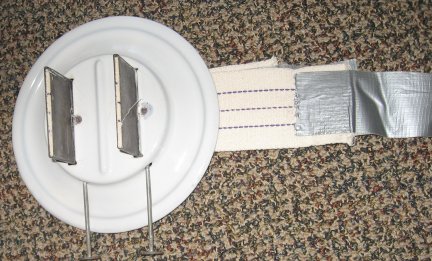
The "Golden Crown Combo" was imported from Holland by Golden Crown Products Co, Jacksonville, Florida. Date unknown, but probably sometime in the 1980's. This is the only one I have ever seen, but certainly more must have been sold. This one had never been lighted, so I was glad I found it in that condition with the wicks unused. | The Golden Crown had a totally nonadjustable wick system. The two parts were the "helper" wick on the right and the burning wick on the upper left. They are 4 1/4" wide cotton wicks. The "helper" wick transported fuel from the tank to the burning wick - the top 3/4" of each wick touched, transferring the fuel. When the cotton wick burnt down 1/8", it required replacement...after only a couple of times burning! That is totally unacceptable, so I made a new wick using a fiberglass edge-burning wick and part of a soda can as the wick holding bracket (low left above). The photo shows a sample wick made for the photograph as too much wick is exposed at the top. If only 1/16" wick is exposed, the heater burns just fine and the fiberglass wick is not consumed in only a few burnings. It works and works well! Heat output is about 5,000 BTU/hr, so it turned out to be a fine little parlor or garage heater. |


Haller - Ditmar - Saffire
|
|
Haller - Ditmar - Saffire | Haller - Valor - Saffire |


The Haller Heater
|
The very unique Haller blue flame heater. Elegant simplicity and beauty. |
|


Above left, a "Haller" heater. Center, the Haller blue flame closeup. Above right is a "Haller Saf-e-fire," apparently a later model. The fuel tanks appears identical, but the Haller tank is brass and the Saf-e-fire tank is steel. The top plate is not as rounded as the earlier model on the left and the Safe-e-fire is not as tall. |
| Haller vs Saf-e-fire The heater tank may have a small metal tag that says "Saffire Made in Holland" and the glass may say "Haller" on one side and on the other say "Jena_er Suprax Glas Made in Germany." The heater on the right appears to be a transition model, marked "Saf-e-fire Made in Holland" on the tag. |

| Haller and Saffire heaters used a twisting system to raise and lower the wick, with the entire top of the heater being turned. The ring shown at left is slipped off the old wick, slipped over the new wick, and reinstalled. The Saffire was made in the same factory, but with a slightly different name: "N. V. Koninklijke Kamper Emaillefabrieken v / h H. Berk & Zoon". Wicks are available here. |

|
|
|
| Tank spring: the wick raises and lowers by twisting the top of the heater. | Wick in lowest position. Note the flame spreader. | Wick in highest position. |


Creative modification for cleaner burning. | "I formed the theory that the effective chimney on the Saffire was too short and tested it by putting a rolled sheet of brass shim stock into the cylinder above and resting on the shoulder of the glass chimney. This obscures the vent slots and almost doubles the effective draught height. It works, and there is now no discernable odor. The usable heat output range has also increased. "I thought this simple trick might be of interest to you. Easy, cheap, effective, reversible and almost invisible. My technique can be improved on by other users. "The shim stock came in a roll about 1 1/2 inches in diameter. I unrolled about 24" , trimmed the width to 5 1/2" and rolled it inside out into a springy cylinder that would expand when released. Then I pushed it into place through the glass chimney from the bottom. "I thought this simple trick might be of interest to you. Easy, cheap, effective, reversible and almost invisible." Phil Botha, South Africa, 7.18.2014 |
| A very unique and beautiful Haller combination stove/heater, shown disassembled. Photo courtesy of Manfred Koster. |


A small Haller heater!
| There was a unique, small Haller heater which looks like a Valor Parlor Stove. It requires the W44 wick. The photos below show the font and burner, and on the right below the wick sleeve which appears identical to the W44 wick sleeve. The diameter is exactly the same. Photographs by the owner, Jean-paul Willems. |

|
|  |


The Facetta Radiant Heater
|
|
Shown above is a Facetta radiant heater. The Facetta was probably made in Kampen in the Netherlands. The company was named "N. V. Koninklijke Kamper Metaalwaren-fabriek v / h H. Berk & Zoon" and used the same wick as the Haller and Safe-e-fire. This is the only radiant flame spreader heater I have ever seen other than the AGA (below). Click photos to enlarge. Photos courtesy of Manfred Koster | |


AGA Heaters
|
| This is a small flame spreader radiant heater with a shielded back, so it could be placed closer to a wall. Note the very rare heating wire coil. Heating coils have been used above the catalytic converter on some heaters, but rarely in conjunction with a flame spreader. The hot heating coil acts as a secondary combustion unit, resulting in a cleaner, more efficient burn, and a thick lens on top concentrates the heat straight up to sustain an excellent convection cycle. Photo courtesy of Manfred Koster |
Note the unique design - a flame spreader radiant heater with the shape of a convection heater! | ||


| The brilliance and ingenuity of design of heaters made in The Netherlands is illustrated by the AGA heater at left. This heater uses the same burner and wick as the AGA above, captures that heat in an oil filled radiator, and then radiates the moderated heat into a room long after the heater is turned off. Mounted on wheels, the heater can easily be rolled from one room to another. Photo courtesy of Manfred Koster |

| Finally, a photo of my AGA and Saf-e-fire heaters. The beauty and simplicity of these heaters from the Netherlands is readily apparent. Thank you, Manfred! Heaters owned and photographed by Miles Stair Wicks for the heaters on this page are available here. |

`
AGA found it`s way from Sweden to Holland. AGA stands for "Akteibolaget Gas Accumulator" (est. 1904) and was founded in Sweden by Gustaf Dal�n, "Nederlandsche Aga Radiatoren- en Apparatenfabriek" was a sub division of the swedish "Akteibolaget Gas Accumulator", so you might say that AGA have been doing a bit of "badge engineering" over the years, Haller products were sold as AGA (like the heater you own) and vice versa (like the propane stove I have). If you check the logo on Manfred Koster`s convection AGA heater and compare it to the logo of the Swedish AGA company found on their website (www.aga.se) you will see the connection. William Sogge, Norway |
Haller "Origineel" stoves
HALLER STOVES
(Click here for Haller HEATERS)
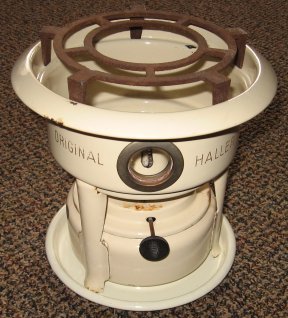
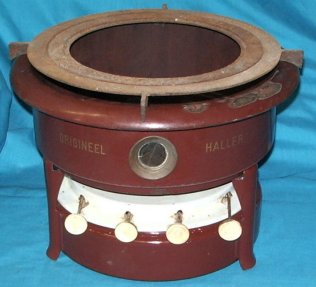
Haller "Origineel" kerosene stoves were originally made by Georg Haller Co of Ottensen (Hamburg), Germany. Haller stoves date from circa 1900, but some variations (clones) were made in the former East Germany and are marked DRG. Production apparently ceased by 1975. Some clones have been found with the name "DOETINCHEM," a large Dutch city, and may have some connection with the later Dutch Haller heaters.
The need for these stoves in the early 1900's was manifest. The Industrial Revolution in Europe was in full vogue, with rural residents being displaced to the cities to find work, so virtually any habitable structure was considered livable even without a kitchen. In those conditions, a Haller stove was indispensable. The most common Haller stove encountered is the single wick design, but models with 2, 3 and even 4 wicks were manufactured. All of the variations I have encountered used the same wick, however.
Haller stoves are of enameled steel construction. The white area visible at the bottom of the stove is the wick holder, and the venting visible allows a considerable amount of fresh oxygen to feed into the 2 3/4" flat wick. These stoves burn very clean and odor-free providing water clear 1K kerosene is used. The fuel reservoir is primitive, however, being nothing more than a basin for the wick, and care must be taken to prevent spilling.
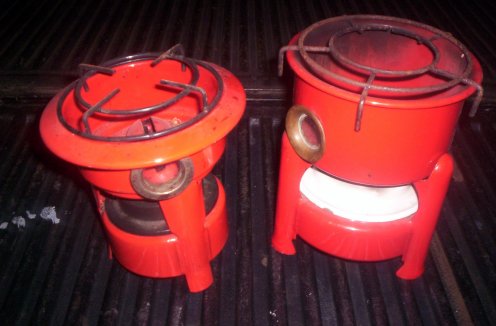
There were at least three grades of Haller stoves. In the photos directly below, the single burner at left is of obvious higher quality than the four stoves on the right. The all-stamped steel 4 burner below right is considerably lighter and made less expensively than my newest 4 burner shown in the bottom photo on this page, with excellent cast iron parts and very heavy, thick metal. A good mid-range stove is the blue Haller below, still stamped steel but heavier and thicker than the cheaper versions at top right.
Haller stoves require a thin, 2 3/4" flat wick as they have precision gear wheels and a narrow wick sleeve.
|  |
|
|
Mint condition single burner, pre-WW I, single wick | Post war East German variations, single, double wick. Can be found labeled "Beccon Origineel" | Pre-WW II variation, single wick (see photos below) | Four wick version, circa WW I |
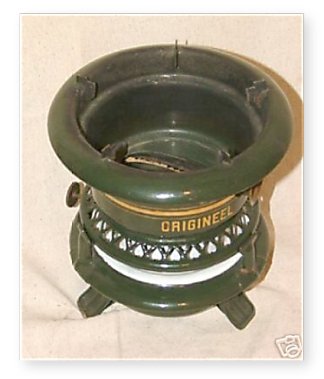
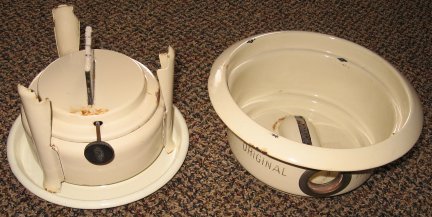
| Assembly photo #1: At left, the top piece is removed from the base. The pot/pan support has already been removed. The simplicity of the design is readily apparent: Note how easy it is to clean the various parts. And you can see that where the enamel chipped, rust appears. Considering that this stove was in use for decades, however, proves the sturdiness of the basic design. |
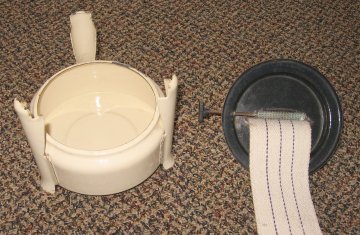
| Assembly photo #2: The wick assembly removed from the fuel reservoir. The reservoir is an open bowl, easy to fill and clean, and just as obvious is that care must be taken when in use so that fuel does not spill. In this photo the base has been removed. For cleanliness in storage, the base fits perfectly over the upper heat chamber, above right in photo #1. |
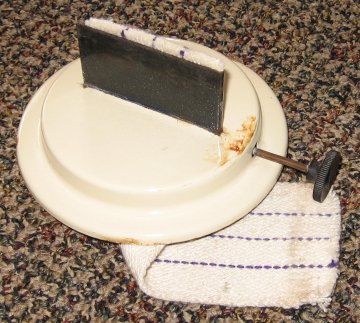
| Assembly photo #3: A new wick has been installed. Because of the tall constricted wick slot, pushing a wick into place through the wick raising gears is extremely difficult. It is vastly easier to pull the wick through from the top. I use a 6" piece of duct tape, with one inch on each side of the wick and the remaining 4" pressed against itself to form a thin wick extension. The duct tape easily slides through the wick slot and the wick is then pulled into place. Note that I bevel the edges of the wick to make it easier to pull through the wick gap in a straight line. |
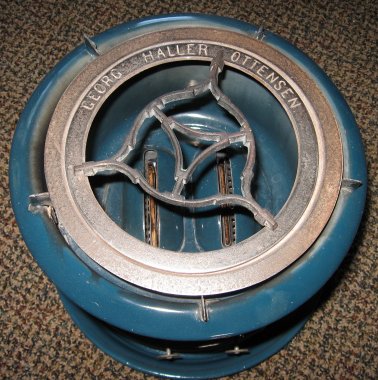
| Haller stove, a recent addition to my collection, a two wick model with all the pot/pan support rings intact. Each ring can be removed to fit the size of the bottom of the pot or pan. The center support is for small pans. The inner ring clearly says Georg Haller, Ottensen. Click photo to enlarge. |
| The photo at left shows the easiest way to install new wicks in a Haller stove. Note the duct tape extensions on the wick. The duct tape is pushed through the wick slots from the top, the wick pulled down level with the top of the wick tubes, then the duct tape can be removed. |
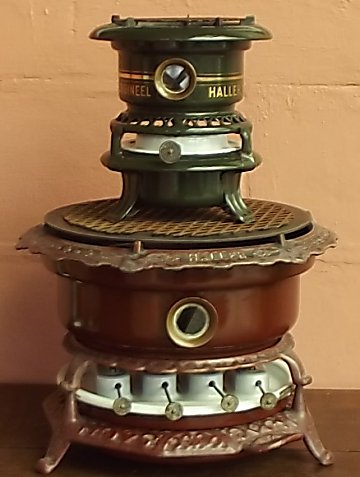
| My latest Haller stove, a four burner, with a pristine single burner on top to illustrate the relative size. This 4 burner was Haller's primo model, more of a range than a pedestrian stove. This grade had three sections of cast iron excluding the burner plates on top, and very heavy gauge enameled steel. The little single burner stove may weigh 2 pounds, but the four burner weighs over 20 pounds! This large, heavy stove was brought to Canada by German immigrants before the Great War of 1914-1917 and kept in the family until finally sold in 2012. |
Haller Stoves used 2 3/4" wide, relatively thin wicks. | |