
Recommendations and test results | Maintenance and storage
Recommendations and test results
RECOMMENDATIONS AND TEST RESULTS
Kerosene Stoves
``````
Jump to...
CANNING WITH A SMALL STOVE
USING A KEROSENE COOKER AS A HEATER
Everyone has a different survival plan, so a "one size fits all" approach to equipment obviously won't work. That, of course, is why there is such a variety of cook stoves, lanterns and heaters available. Because of this problem, I have chosen to concentrate on equipment which will meet the needs of the two most divergent ideologies - mobile survival mode or fixed location survival.
MOBILE SURVIVAL MODE
Let us assume someone from Southern California is gathering survival equipment. What hazards to they face? The San Andreas "Big One" earthquake is an obvious reason to be prepared, as if it fractured there would be no water, electricity, natural gas or food available. In addition, the vast population of the area would become like a cloud of locusts, devouring everything available almost immediately. [This could apply to many scenarios = war, terrorism, etc.] The smart move would be to evacuate the area at the first opportunity, and that means having portable survival equipment already packed and ready to go. This subject is covered very well, complete with lists and "how to" information, in my booklet "Evacuation and Relocation."
|
|


The Butterfly #2412 pressure stove is made to disassemble and can be safe for travel. Being of all brass construction and with the pressure pump being the only moving part, these stove can be depended upon to last virtually forever. There is a cap on the end of the plunger which can be used to seal the fuel tank - after the burner is removed. The #2412 is a small pressure stove with a #1 burner, but puts out at least 6,000 BTU, which is more than enough for cooking. It also will burn about any fuel that pours, although thicker fuel may require 2 or more preheatings with alcohol before it will burn. For indoors use, only kerosene should be used, as burning kerosene produces almost no carbon monoxide.
"Butterfly" kerosene stoves are available from www.StPaulMercantile.com . St Paul Mercantile is highly recommended. Their prices are low and service is high - a great combination! |
You will need to make up your own kit bag for travel use of the Butterfly #2412. The burner can be removed, but it is sooty and therefore should be kept in a plastic baggy. The upright supports should be stored in a separate bag so they do not get lost, as should the jet picks. The legs should have rubber feet installed to prevent scratching of table surfaces: the tips for door stops can be glued on the bottom of the legs.
FIXED BASE COOKING STOVES
There are two basic design concepts for kerosene cooking stoves available today, the gravity flow system and the multiple-wick models.
Gravity Flow Stoves
|
|
|
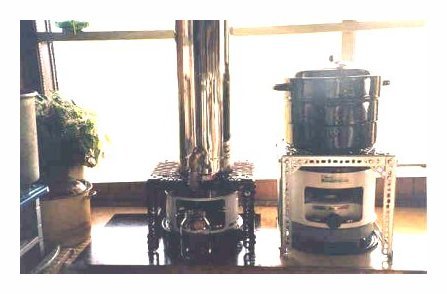
Here is a set-up on my porch. #2418 on left, two stoves under cook stands, a bottling tank on left and waterbatch canner right. | ||
|
|
|
Butterfly #2419 | Butterfly burner lifted | Butterfly #2417 |




Gravity flow, edge-burning wick stoves date back to the 1920's when they were made in the millions by Boss, Perfection, Florence and many others. Millions of housewives used these stoves for their everyday cooking needs until Rural Electrification was completed in the 1950's. The basic design was shamelessly copied by Butterfly because it was proven to work for decades. These stoves use a wick which fits on edge into a slot. The red knob (above) is opened and fuel flows from the glass reservoir through the tubing, through the valve controlled by the red knob, and into the slot with the wick. The directions for use are the same for all of the stoves.
The advantage of these stoves are there are no moving parts except for the fuel flow valve. The 7/8" wide wicks are made from fiberglass woven around a copper mesh, so the wicks last for a long time in daily use. Every time the stove is turned off the wick burns clean, so maintenance is not frequently required. Thus the stoves can be used to cook meals every day with a minimum of effort and fuss. The maximum output of 7,000 BTU/hr per burner is sufficient for most cooking and baking requirements, but marginal for heavy duty use such as canning.
Which model to choose for your own individual requirements depends upon how much you plan to cook, how much space you have available, etc. I gave my mother a single burner #2413 during Y2K, for example, because she was familiar with these stoves, having used on during The Depression. I have a #2418 and have used it frequently. I gave a double-burner #2416 to my church for use during power outages because it has legs and could be brought out for use as required. The double-and triple-burner models are best-sellers to homemakers in Asia, being used as their only cook stove.
Be absolutely sure to order order extra wicks.
Multiple-Wick Stoves
|
|
|
Butterfly #2648 | Butterfly #2648 | |
The #2641 is a no-frills 10-wick stove, but it's inexpensive and it will boil water for coffee and cook dinner when the power goes out. | A strong, 2-burner, 10 wick stove. 7,000 BTU/hr per burner. These are versatile stoves and could be used for everyday use. | The photo above illustrates the size of the #2648 stove top, and the grate will hold the #2421 oven securely. |


|
|
|
This 16-wick stove produces 10,500 BTU/hr maximum. The cook top holds the oven securely and is wide enough to hold a waterbath canner with ease. The open sides provide easy lighting of the wicks. This may be the most versatile multi-wick stove. | Maximum heat of 14,000 BTU/hr. Large and strong enough to hold a large kettle, with enough heat output to quickly boil a lot of water. For heavy duty, frequent use canning or baking, this is the stove. The steel grill is very stout and the round design of the body is inherently strong. | An all-aluminum stove that should last for decades. Same output as the #2698, but lighter and easier to carry. This stove is used in restaurants in Asia. If you only use a large stove once a year for canning, this is the one to have because it will not rust in storage. Easy to light. |


Multi-wick stoves use cotton strands as wicks. The number of wicks determines the heat output. The wicks are pulled through the wick tubes and the red knob visible above on each heater raises a plate so all wicks raise and lower simultaneously. The wicks are inexpensive and in an emergency you can liberate cotton strands from a mop head to re-wick a stove. The stoves are all metal, only one moving part, and if cared for will last decades.
Each of the various multi-wick stoves above fits a specific purpose. I prefer the #2487 and A-822 for ease of lighting because of their open sides, but the #2698 has a definite purpose as a heavy duty stove. The two-burner #2648 is amazingly versatile at an inexpensive price. For everyday use it is just fine: 7,000 BTU output is more than sufficient for normal cooking requirements. Those who simply want to have a stove stored for power outages will find the 10-wick #2641 extremely handy during emergencies.
Pages on this web site:
Kerosene Stoves, Lanterns and Ovens
- Kerosene Stoves - Recommendations on different models New!
- Kerosene Stove Maintenance and Storage
- Butterfly A-822, 22 wick, all-aluminum premium stove. New!
- Butterfly #2487, 16 wick stove.
- Butterfly #2412 Pressure Stove;
- instructions for virtually any pressure stove.
- Butterfly #2418 Double Burner Stove;
- good with any gravity flow stove.
- Butterfly #2421 Oven for Kerosene Stoves
- Butterfly #2641, 10 Wick Stove -
- the least expensive emergency stove.
- Butterfly #2698 Cook Stove -
- THE Best Heavy Duty Cook Stove.
- Butterfly #828R Pressure Lantern;
- same for most pressure lanterns.
- Haller "Origineel" Stoves
- Mini kerosene heaters;
- also mini stoves made from old brooder lamps.
- Sad Iron stoves;
- examples of, and wick replacement. Wicks are here.
- "Wickless" Stoves & Ranges,
- and wicking for them.
Older Butterfly stoves from Y2K sometimes surface in new condition, the box never even opened. Some of those older stoves were very inexpensive when made and sold and need a little more care to set them up properly. The cooking stand can also be of great help for supporting an oven or even a canner.
Non-Electric Cooking & Kitchen Equipment
USING A KEROSENE COOKER AS A HEATER
Kerosene cookers can be used as an emergency heat source. I have used the Alpaca, Butterfly, Premier Sr. and Swastik stoves as heaters in my greenhouse on extremely cold winter days. And yes, I have used them in the house for heating as well. The burner unit on a cooker lacks a flame plate on top, as do kerosene heaters: the flame is designed to impact a solid surface directly at the cooking surface. I use an 8" x 8" x 3 5/8" concrete block (or a round steel plate) on top of the units when using them for heating. The flame is adjusted to a bright blue, with no yellow showing, and the concrete block acts as a heat sink, moderating and dissipating the heat. Don't laugh -- it works.
The Alpaca needs to be burned at nearly maximum heat output, however, or the fiberglass wick will foul with tar balls and burn poorly. In fact, I've had them literally go out when used for extended periods of time as heaters because of tar ball buildup on the wicks. Then the tar balls need to be crunched with a pair of smooth, paddle bladed pliers just so the wick can retract! A cotton wick used in an Alpaca solves that problem. With a multi-wick stove like the Butterfly, you can simply snip off the top of the wicks, pull them up a little, and have a fresh surface to burn.
| HEAT SINKS FOR STOVES Butterfly #2457 on left with a concrete block. Butterfly #2628 in center holding a 1/4" steel plate. Alpaca on right heating a diffuser plate. |

CANNING WITH A SMALL STOVE
The stove top strength of all but the #2487 and #2698, in my opinion, are not large or strong enough to safely support the width and weight of a loaded water bath canner. Yes, it could be done, but it is much better to build a cook stand...the stove fits underneath the stand, and the stand itself supports all the weight of a very wide, heavy canner. If you do not have the scrap metal on hand to build a cooking stand (below), it is actually less expensive to buy a #2687 and have not only a spare stove, but a hotter stove. Canning with only one single-burner stove is NOT desirable! For example, how do you simmer the lids? A small, everyday meal cooking stove combined with a larger, hotter canning stove makes canning safe and efficient.
A cooking stand may be made using inexpensive pre-drilled 1 1/2" angle iron or the legs and top bracing, and a piece of "expanded" steel bolted to the top.
|
|

Maintenance and storage
Kerosene Stove Maintenance and StorageJust after World War I, Boss and Perfection began using a "burner unit," or catalytic converter, on their stoves. The basic design is unchanged to this day because it works. In essence, the catalytic converter is comprised of two perforated bare carbon steel cylinders with two through-pins holding the cylinders within a strong enameled steel outer cylinder. The design allows the inner cylinders to "float" or move, so they can seat squarely.
The photo above shows the base of a catalytic converter. Click on the photo to enlarge it. | The two inner cylinders of the catalytic converter are spaced so that one fits inside the wick(s) and one fits outside, so the wick(s) are between the two perforated cylinders. The wick(s) bring fuel to the base of the cylinders through capillary action. When the catalytic converter is up to operating temperature, the fuel vapor is combined with oxygen flowing through the perforations. The flame is then between the cylinders, not from the wick(s) - the rings convert fuel vapor to clean, virtually odor-free flame heat. This principle applies whether the wick is an edge-burning type in a gravity flow stove, a single circular wick as in a Boss or Perfection, or a multi-wick stove as are many stoves made by Butterfly. |
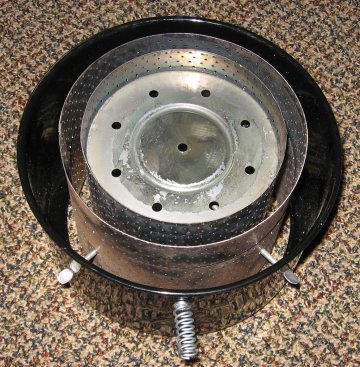
The two steel cylinders of the catalytic converter are soft and easily damaged. Even if made from hardened steel, the heat produced by the stove in use would quickly anneal the cylinders and make them soft. Normal bouncing during transit, storage or use can result in nicks or an uneven bottom edge of the converter rings. If the bottom edge of the burner rings is not perfectly flat, an air leak and cause extra oxygen to enter the space between the cylinders, upsetting the delicate air/fuel mixture and causing an flame spike. And that air spike will cause sooting if it is high enough to impact the bottom of a pot or pan.
An "flame spike" can be caused by too high a wick in a multi-wick stove as well as an air leak. To determine the problem, grab the wire handle (see photo above) on the catalytic converter and move it slowly from side to side while watching the flame. If the flame spike does not move, the cause is a wick too high. Remember the location (10:30, 3:00 o'clock, whatever), cool the stove, remove the catalytic converter, and trim down the offending wick.
If the flame spike moves with the catalytic converter, the cause of the flame spike is an air leak. That is easy to fix. Place a new sheet of sandpaper of 120 to 150 grit on a flat surface, like a Formica countertop. Place the catalytic converter base down on the sandpaper close to you and hold an edge of the sandpaper down against the countertop. Then gently stroke the catalytic converter away from you, one stroke!, while keeping the catalytic converter as flat as possible. Lift the catalytic converter and return it to the near edge, then make another stroke. Now you can examine the bottom edge of each cylinder. The shiny spots were high spots that were sanded down. The dull places are too low and will cause an air leak. Repeat the sanding strokes until both cylinders are shiny rings all the way around. Bingo, no air leak.
That whole operation takes less than 10 minutes, and your kerosene stove will now burn properly. Now the wicks can be raised higher, producing more heat without a flame spike causing sooting on your pots and pans.
STORAGE
Be sure to store the stove "dry," empty of fuel, to avoid any condensation in the fuel tank. After the fuel is emptied from the tank, light the wicks, assemble the stove, and let it burn for a half hour or so until all fuel is out of the wicks - the flame will go down demonstrably. Lower the wicks while peeking under the catalytic converter so that just a little flame is showing (perhaps 1/8" or so of wick exposed), then re-seat the catalytic converter. The wicks are cotton so they will burn when dry. As the last of the fuel is burnt from the wicks, the wicks themselves will burn, which will burn off any carbon deposits. The wicks will burn down to the top of the wick tubes - and they will be nice and even in height, perfect for the next use of the stove.
At this point, the stove should be taken apart and given a nice coat of polish. Normal liquid auto polish should be applied to all surfaces, inside and out. All it takes in about 15 minutes, and the pores of the enamel are filled, the stove will not rust in storage, nor will spilled food cause any stains.
The catalytic converter should be examined. If dirty or sooty, the guide rods should be removed and the cylinders washed in hot, soapy water until clean. If not too bad, a thin brush can be employed to brush off the cylinders. If the stove is to be stored indoors in a dry place, nothing else need be done to the catalytic converter. If, however, the stove is to be stored in a garage or anyplace with a high humidity, the cylinders need to be oiled to prevent rusting.
Finally, store the stove in a tight fitting box, and seal the box. The next time you need the stove it will be absolutely ready to use. Just fill with fuel, wait a half hour for the wicks to suck up fuel, and light it.
`
Kerosene Stoves, Lanterns and Ovens